Over-Scoped AI Diffs and Reviewer Cognitive Load
Bloated AI diffs overload reviewers, and tighter scope alone won't fix it.
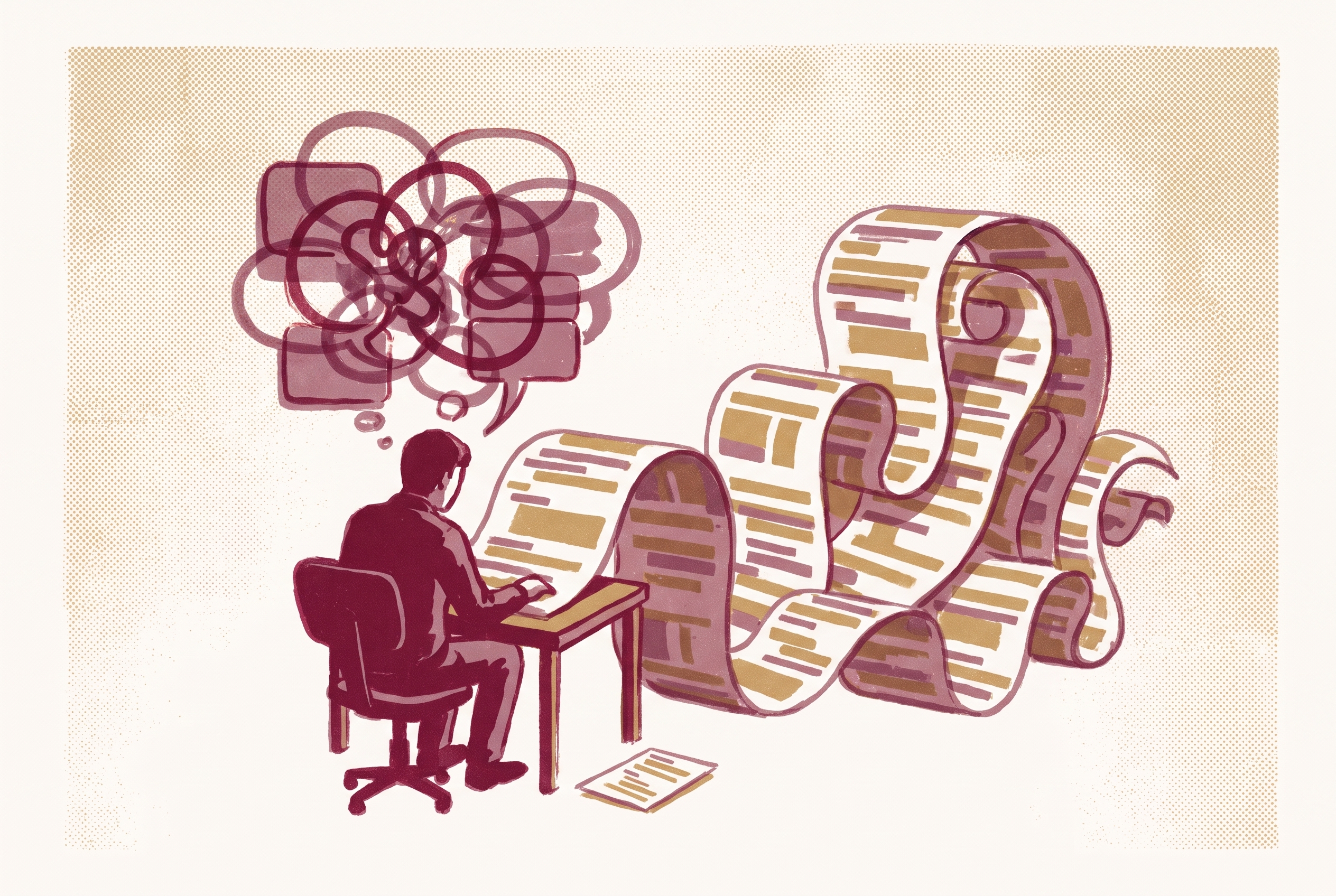
Over-scoped AI-generated diffs create a structural mismatch between code production and human review capacity. Scope inflation and cognitive density compound each other, forcing reviewers to reconstruct more context while judging more decisions without reliable signals of uncertainty. Improving review quality therefore requires both tighter scope and a workflow that supports understanding, risk assessment, and author engagement before a pull request reaches review.
How AI coding agents broke the production-to-review balance
AI coding agents accelerate production without providing a matching increase in human review capacity. Generation can run in parallel, continuously, without fatigue, while human review remains serial and cognitively expensive. Every generated change still needs someone to judge its behavior, security, and architectural fit. Those judgments take time even when writing code has become faster. The resulting imbalance moves the constraint downstream, from producing code to deciding whether it belongs in production.
Salesforce Engineering documented that shift as AI-assisted tooling increased code volume. Pull requests often grew beyond 20 files and thousands of lines of change, while review latency rose from quarter to quarter. The delivery pipeline did not accelerate in proportion. Review, security validation, and architectural judgment took over from code writing as the work that held up delivery. This is an architectural problem in the delivery process.
A growing queue can arise when code is produced faster than the system can review it closely, even when reviewers are disciplined. Adding generated output then increases the unresolved work waiting for human judgment. Production speed alone gives only part of the picture of progress. Its value depends on whether the rest of the workflow can absorb the changes without reducing the scrutiny applied to them.
Why PR size alone understates the reviewer's actual burden
LinearB’s 2026 Software Engineering Benchmarks, drawn from millions of pull requests, found substantially larger AI-assisted pull requests at the 75th percentile than unassisted ones. That increase expands the context a reviewer must reconstruct. A multi-file change requires more than reading each file independently because behavior depends on relationships among the changed parts. The reviewer must keep those relationships in mind while reading new code. Line count captures the volume of text, but not all the work needed to understand it.
Nelson Cowan’s 2001 review of the evidence placed usable short-term storage at roughly four chunks. A chunk is a meaningful unit of understanding. Experienced reviewers work around this limit by spotting patterns they know and treating several connected details as one unit. That advantage depends on familiarity with the codebase. As AI-generated volume changes more of the surrounding code, the reviewer’s prebuilt chunks can become stale, requiring reconstruction.
A twelve-file diff therefore creates a navigation problem as well as a reading problem. Reviewers encounter files in the order the tool presents them, build a partial model, and lose earlier context as new details compete for attention. They must repeatedly page their own memory back and forth. CodeRabbit identifies context drift as an additional burden when agent-generated changes extend beyond the original scope or introduce patterns unsuited to the broader codebase. The reviewer must then understand both the implementation and why its boundaries no longer match the requested work.
The second mechanism — AI-generated code is denser than its line count suggests
Scope inflation becomes more expensive when the code also demands more judgment per line. An AI diff is not necessarily equivalent to a human diff of the same length because the reviewer has different evidence available for allocating attention. With a colleague’s work, knowledge of that person’s experience and familiarity with the codebase provides context. A question on Slack can also recover a rationale quickly. An LLM does not provide that same social scaffolding, even when a human remains accountable for its output.
JetBrains Research’s October 2026 study, based on participatory design with 17 practitioners and a follow-up survey with 43 software professionals, identifies a central difficulty. A language model presents generated code with the same apparent confidence regardless of its underlying uncertainty. Authentication logic and a database migration can both look just as certain. The presentation does not tell the reviewer where generation was straightforward and where it was a stretch. Without that distinction, any line may warrant close inspection, turning review into an audit that scales poorly with changeset size.
Surface polish makes this allocation problem harder. CodeRabbit identifies generated code that compiles, follows style guides, and passes baseline tests while remaining vulnerable under load, at edge cases, or with invalid inputs. The defects are in the logic, while the syntax is sound. The visual cues reviewers know therefore do less to show them where to look more closely. Reviewers may need to think through a clean-looking implementation at length to understand how it behaves.
Human-authored changes can also show what the author intended through the order of commits, the files given emphasis, and descriptions that say where the author was unsure. When an agent emits the whole change at once, the reviewer inherits work that an author would otherwise have absorbed by structuring it. More code requires examination, and each part requires more reconstruction because the usual context is missing. A size limit reduces the amount presented at once, but it does not restore the evidence needed to judge each part.
What reviewers actually do when scope and density exceed working memory
When the required reasoning exceeds working-memory capacity, reviewers must make triage decisions. They may defer the change, skim it, or approve it without meaningful inspection. These responses differ in their effect on throughput, but each reflects pressure that cannot be resolved by sustained attention alone. Deferral preserves the possibility of deeper review while extending the queue. Skimming and rubber-stamping move work forward by reducing the depth of inspection.
Salesforce observed a particularly revealing pattern in its largest pull requests. Review time began to plateau or even decline, which it attributed to cognitive overload and context-switching. Shorter review time was not straightforward evidence of greater efficiency. In this setting, it was a warning that larger changes were no longer receiving proportionately deeper engagement.
This produces a throughput paradox in high-adoption AI workflows. Teams can merge substantially more pull requests while spending far more time in review, even as the depth of inspection falls. Time can be consumed by rebuilding context and navigating large changes rather than testing the assumptions that determine correctness. Treating this as reviewer failure misses the mechanism that makes those trade-offs rational under structural pressure.
Cognitive disengagement starts before the PR is opened, not at review time
The reviewer may not be the first person unable to keep pace with the generated output. A CHI 2026 formative study of software engineers using an agentic coding assistant found that cognitive engagement consistently declined as tasks progressed. Developers invested most heavily during planning, disengaged during execution as output volume overwhelmed them, and allocated minimal cognitive resources during evaluation. They largely neglected to verify the underlying process that produced the output. The loss of engagement began before review was possible.
A human-authored change can arrive with an author who has already reasoned through its construction and can explain the relevant trade-offs. An agent-generated change may arrive after its owner has only partially followed the implementation. Accountability alone does not supply the missing understanding. The reviewer then faces unresolved assumptions from the authoring stage in addition to the scope and density of the diff itself.
This is the strongest complication for a smaller-PR-only response. Dividing generated output into shorter changes does not establish that someone has examined the reasoning behind them. A small diff can still lack a decision history and present uncertain choices with uniform confidence. JetBrains frames the broader issue as trust calibration, in which review effort should be proportionate to segment-level risk. If confidence signals are absent throughout authoring and review, the workflow leaves that allocation unsupported at both stages.
Why the standard diff viewer is the wrong tool for this class of problem
A standard diff viewer makes textual change visible. It does not, by itself, establish where the reviewer should trust the implementation or invest additional skepticism. JetBrains describes reviewing LLM-generated multi-file changes as a trust-calibration problem. The distinction separates comprehension from judgment about reliability. A reviewer may understand what changed and still lack the evidence needed to decide which parts deserve deeper investigation.
A flat view shows files and lines without ranking them in a way that helps reviewers judge how much to trust them. Authentication logic and a formatting pass can look the same in the viewer even though they need different kinds of review. The display also does not inherently distinguish a well-tested subsystem change from one whose behavior remains uncertain. Everything arrives at the same level of presentation. The reviewer must construct a risk model while simultaneously constructing a model of the code.
Shneiderman’s information-visualization principle offers a contrasting structure, beginning with an overview, then zooming and filtering, and finally providing details on demand. That sequence matches the need to understand unfamiliar code before examining its smallest parts. A traditional line-by-line diff instead pushes the reviewer directly into details. The cost is greatest when the changeset is large and familiar chunks are unavailable. Each new detail then competes for attention before the reviewer has a stable structure in which to place it.
The absence of an intent anchor compounds this problem. CodeRabbit notes that pull request descriptions can summarize what an agent generated and leave what the team requested unstated. Such a description explains the output without establishing the standard against which it should be judged. Implementation details become the frame for review. The reviewer can assess whether the code is internally coherent while still missing whether it delivers the intended behavior.
What a review workflow designed for AI-generated diffs actually requires
The practical response is to establish intent before opening the diff. The linked ticket should serve as the definitive source of intent, with expected behavior and acceptance criteria defined before implementation details become the focus. CodeRabbit recommends this pre-diff stage, including titles aligned with behavioral goals and separation of generated changes from mechanical edits. This gives review an external anchor.
Reading order should then follow dependencies. Schemas, shared types, interfaces, configurations, and migrations provide the foundation for understanding dependent logic. Beginning there allows reviewers to build a coherent partial model before encountering more complex changes. Each layer supplies context for the next. This helps reviewers group separate details into chunks they can use, even though working-memory capacity stays the same.
Trust allocation also needs an explicit place in the workflow. JetBrains proposes three levels of review, comprising high-level hypothesis formation, selective drill-down to validate hypotheses, and details on demand. Its framework calls for risk and confidence signals at the granularity where developers direct their attention. This remains a conceptual proposal. It helps reviewers use evidence about risk to decide where to look closely, freeing them from having to give every line the same attention.
The emerging Spec-Driven Code Review model, submitted to AIware 2026, provides a related way to anchor judgment. It asks whether a diff matches a pre-agreed specification and organizes review into planning, execution, and artifact persistence phases. Specifications move from background context to first-class review artifacts. The criterion is independent of diff size. That supplies a stable target against which implementation can be evaluated.
Scope still requires an enforced constraint. PR size limits should be rules enforced by CI rather than social guidelines, because agents lack the friction that kept human-authored changes smaller. AI first-pass review does not eliminate this requirement. Early tools caught defects that were obvious in the syntax but missed architectural coherence, intent alignment, and edge-case behavior under load, and there is still debate over whether current tools can reason through what those tools missed.
No single intervention addresses both mechanisms at once. Enforced size limits constrain scope inflation, while dependency-aware reading and explicit trust allocation address cognitive density. Author-side disengagement adds a further requirement that process discipline begin before PR creation. A review workflow cannot reliably recover understanding that neither author nor reviewer had the capacity to build. Its design must preserve that understanding throughout production, rather than leave the final diff as the first place where the reasoning begins.
Notes
- Our Framework for Reviewing AI-Generated Code - The JetBrains Blog
Supplied the study of 17 practitioners and 43 survey respondents, the trust-calibration framing, and the three-level review framework.
Every new piece from The Rejected PR, as it's published.
Follow